
Your Leading CMOS Spectrometer Manufacturer in China
CMOS (Complementary Metal-Oxide-Semiconductor) and CCD (Charge-Coupled Device) represent the two most prevalent solid-state detection technologies currently employed in atomic emission spectrometers.
Soohow Instruments is one of the few domestic manufacturers to have mastered the core technologies for both CMOS and CCD; from optical system design and signal acquisition to full-spectrum analysis algorithms, every aspect has undergone independent R&D and extensive optimization. For foundry enterprises, CMOS spectrometers meet the demands for high-frequency, furnace-side testing through their rapid response capabilities; for mechanical manufacturing firms, their portable design enables rapid, on-site screening for equipment wear; and for the recycling industry, they facilitate accurate metal composition analysis to support value assessment. With their high-speed data acquisition and stable, reliable performance.
Soohow CMOS spectrometers have emerged as a highly efficient choice for elemental analysis across a wide range of industries.
A Variety of CMOS Spectrometers for You
In spectral analysis, CMOS spectrometers are capable of acquiring information from thousands of spectral lines at higher frame rates, making them particularly well-suited for field detection scenarios that demand rapid response and high-throughput analysis.
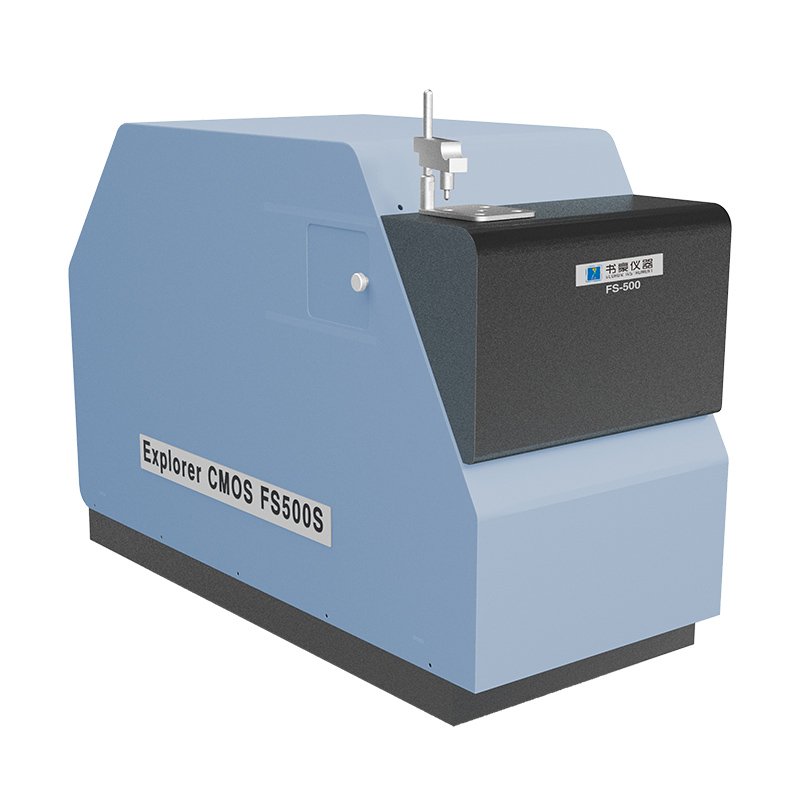 FS500S CMOS Based Spark Optical Emssion Spectrometer
While maintaining high resolution, it significantly enhances readout speed and dynamic response capabilities, making it suitable for production environments that require rapid analysis.
Both are solid-state detectors, but each possesses distinct characteristics:
CMOS: Features fast readout speeds, low power consumption, and strong resistance to strong-light blooming; it is well-suited for high-throughput rapid analysis and portable field instrumentation.
CCD: Characterized by large pixel sizes, high full-well capacity, superior signal integration capabilities under low-light conditions, and low readout noise; it is ideal for trace element detection and the analysis of complex matrices.
Selection Recommendation: Choose CMOS if your priority is analytical efficiency and portability; choose CCD if you require the ultimate signal-to-noise ratio and trace detection capabilities.
Soohow provides a comprehensive warranty covering the entire instrument. During the warranty period, any components damaged due to non-human factors will be repaired or replaced free of charge. The warranty period commences on the date the installation and commissioning are completed and confirmed by the user’s signature. Throughout the warranty period, you are entitled to free software upgrades, free guidance on standardized calibration, and free remote technical support. Upon the expiration of the warranty period, you may choose to purchase an extended warranty service or opt for per-incident repair services; Soohow is committed to providing you with repair parts and technical support for the lifetime of the product.
Modern CMOS spectrometers have significantly narrowed the gap with CCD through the use of back-illuminated technology and noise suppression circuitry. In routine ppm-level analysis, the accuracy of both technologies is comparable; however, in sub-ppm trace detection, CCD still retain a slight advantage. Soohow CMOS spectrometers employ an optical system on par with that of CCD (featuring a focal length of 500 mm and a grating density of 2700 lines/mm), achieving a detection limit of less than 1 ppm—thereby satisfying the vast majority of industrial detection requirements.
Direct analysis of powders is generally ineffective because their loose nature and high contact resistance make it difficult to establish a stable electrical discharge. Indirect methods are therefore recommended: the powder can be pressed into a compact pellet (requiring sufficient pressure to ensure adequate density and conductivity), or a specialized powder fixture can be used in conjunction with a flux to fuse the material into a solid block. The Soohow technical team can provide specific sample preparation recommendations tailored to the physical form of your samples. For metal powders, the use of a Hollow Cathode Discharge spectrometer (Model HCD1000) may also be considered.
Foundry Furnace-Side Analysis: Requires rapid results to guide adjustments to material composition.
On-site Equipment Inspection: Requires lightweight devices to detect wear metals in lubricants.
Metal Recycling and Sorting: Requires high-frequency analysis of large batches of samples.
Field Operations: Requires portable devices featuring low power consumption and vehicle-based power compatibility.
In-line Production Monitoring: Requires continuous data acquisition to track process fluctuations.